Interoperability is often presented as a problem of messaging, i.e. “How do you notify another chain that something happened?” This mental model has defined how incumbent interoperability protocols were designed: elaborate message passing systems for sending, receiving and verifying notifications.
But what if there’s a better way?
Instead of sending messages, what if you could let any application execute a transaction, simply by proving against data on another chain?
That’s the shift Polymer is delivering with the Prove API.
What Matters Most - Adoption
At Polymer, we believe that interoperability should be an advantage, not a burden. Proofs unlock a cleaner, faster, and more secure way to scale apps across an evolving interoperability landscape.
Great tech gets attention. Great distribution gets adoption. Only one builds a product that’s real.
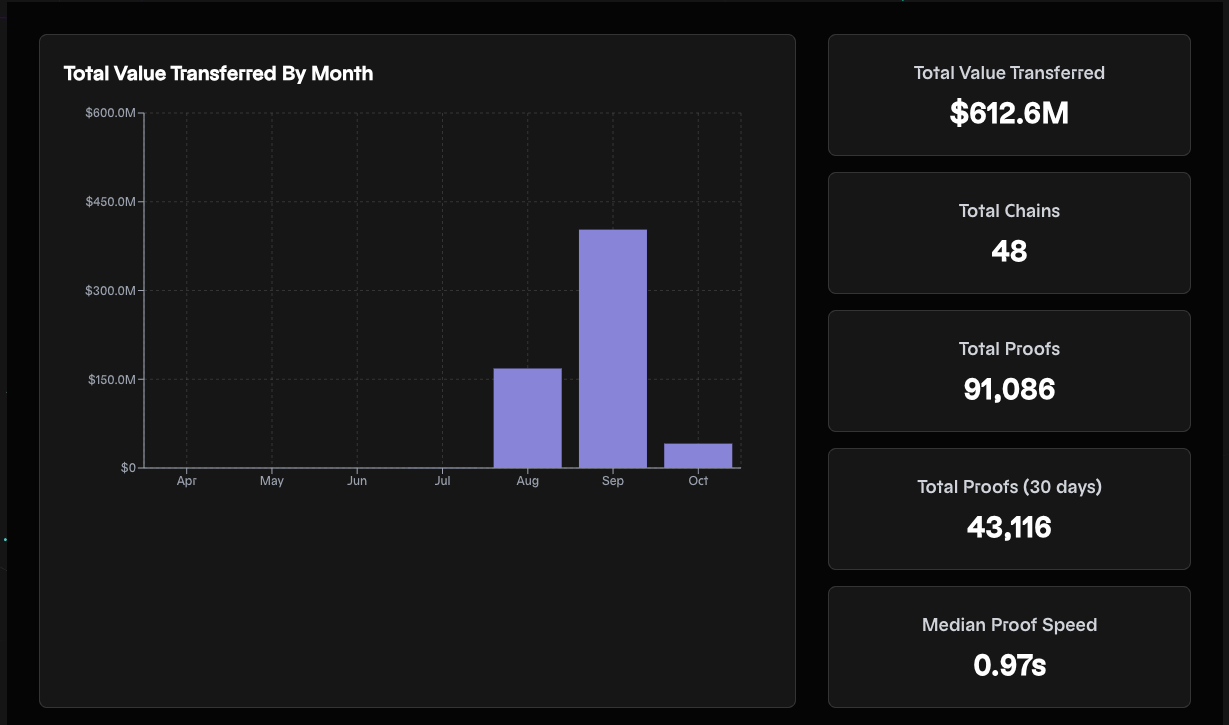
Since deploying in July, the Prove API has facilitated more than $600M in volume, with a median latency of 0.97s. Integrations with key partners across multiple product verticals in Q4 2025 are expected to drive volumes higher before year end.
We are entering an era where traditional banking and payment infrastructure are adopting on-chain rails for better performance and returns.
Polymer offers a battle-tested solution that helps crypto applications unlock faster txs, achieve economies of scale, and deliver seamless real-time UX to end-users–to ultimately reach parity with web2 entrants.
A Simpler Foundation for Interop
The Prove API simplifies interoperability from an extensive multistep operation to a call function. Any application can query and verify on-chain data (events) from Polymer’s network of 45+ chains, to execute a corresponding crosschain action.
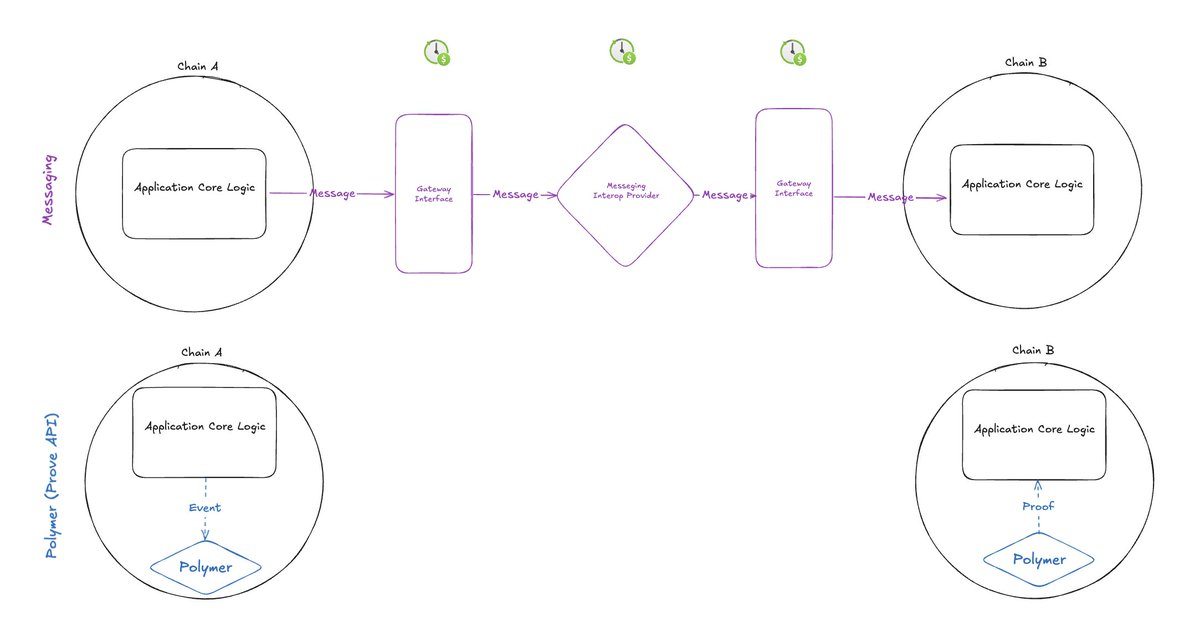
Instead of sending a message of an event, applications prove an event happened using on-chain data. No external oracles. No clunky message-passing systems. Just direct, verifiable merkle proofs generated by the application for its own needs
Proofs unlock the following improvements over message passing:
Expiring Message → Shared History: Instead of creating and sending messages only when a transaction is initiated, Polymer lets applications generate proofs using historic and real-time state data derived from a unified source (i.e. State Streaming).
**Point-To-Point Interop → Open Interop: **Proofs can be constructed from state data across multiple chains, and requested from any chain to any chain within Polymer’s network. Messages are confined unidirectionally chain-to-chain.
Token-Centric → Use-case Agnostic:** **Polymer proofs can be adopted for any crosschain use case, e.g. token bridges, yield streaming, intents etc. to improve crosschain performance.
**External System → Internal Function: By reading directly from application events, **Polymer makes application contracts directly interoperable between chains. Crosschain events are proven natively as part of an application’s flow, not outsourced to an external protocol.
These characteristics create a more reliable, scalable, and future-proof base layer for crosschain applications, while pushing the boundaries of interop performance and usability. Most crosschain transactions on Polymer take less than ~1s end to end, with a 99.9% cost reduction vs traditional message passing protocols.
Build Across Chains as One
Building cross-chain applications has traditionally involved repetitive integrations and complex bridging contracts for each chain pair. For reference, to achieve interoperability among six different chains, a total of 30 integrations are necessary to facilitate all possible chain-to-chain routes.
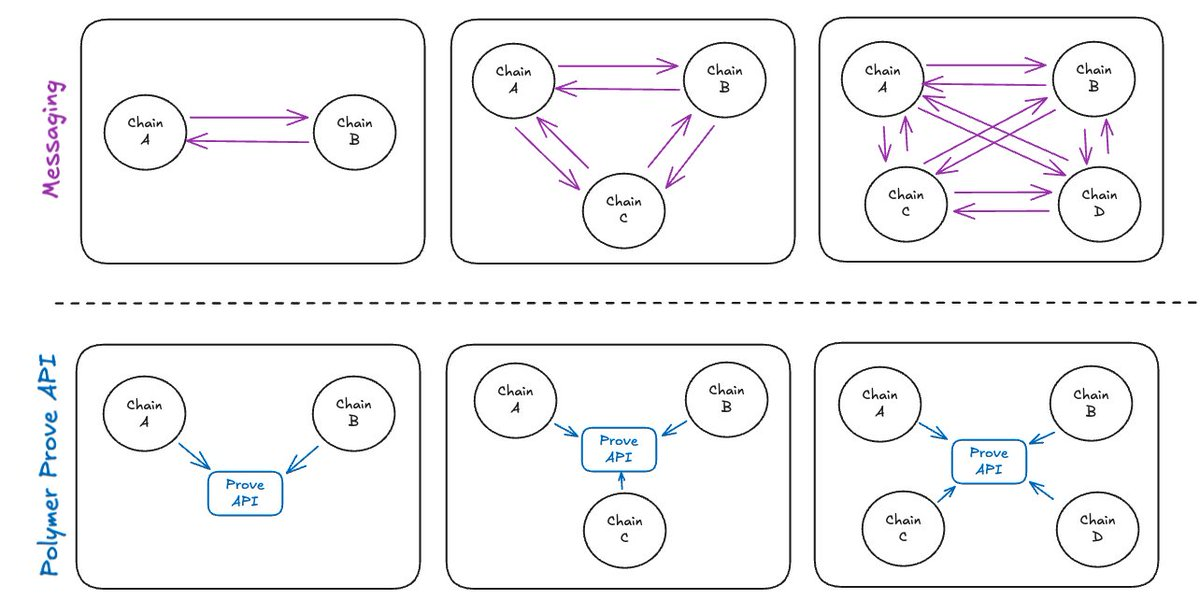
Using proofs, Polymer abstracts away all labor and complexity with a lightweight, one-to-all API, allowing developers to scale their app across dozens of chains with the same ease as building on a single chain.
Minimal Overhead: Interop is plug and play. Existing smart contracts become interoperable. No special interface changes or contract modifications needed.
Universal Connectivity: No chain is unreachable. Developers can easily scale across EVM L1s, L2, Solana, Tron, and Plasma at no additional expansion cost. Polymer removes the concepts of needing to configure and re-configure routes. Simply deploy your app to a new chain and have interop access.
Developer Flexibility: Add a proof verification step to any application flow. Developers choose when, why, and how crosschain actions happen.
By relying on proofs instead of messages, apps stay adaptable — even as the crosschain landscape evolves.
If you’re ready to scale your app, explore the Prove API documentation and start building today.
Docs: Developer Docs | Learn More